
The Mirror Across the Ocean
The success of Zohran Mamdani and Ghazala Hashmi shows how diaspora politics can thrive even as representation dies at its source.

On November 4, 2025, two remarkable victories took place across the American political landscape. Zohran Mamdani, born to Indian parents in Uganda and raised in the United States, became New York City’s new mayor. In Virginia, Ghazala Hashmi, born in Hyderabad and long settled in the United States, was elected as the state’s Lieutenant Governor. Both are Indian-origin Muslims. Both campaigned on progressive platforms that foregrounded issues of housing, education, and social equity. And both won decisively.
Individually, their victories are historic. Together, they mark something larger: the emergence of Indian-origin Muslims as visible, respected participants in American public life. In a country where Muslims constitute barely one percent of the population, these wins represent the culmination of years of quiet groundwork, coalition-building, and political courage.
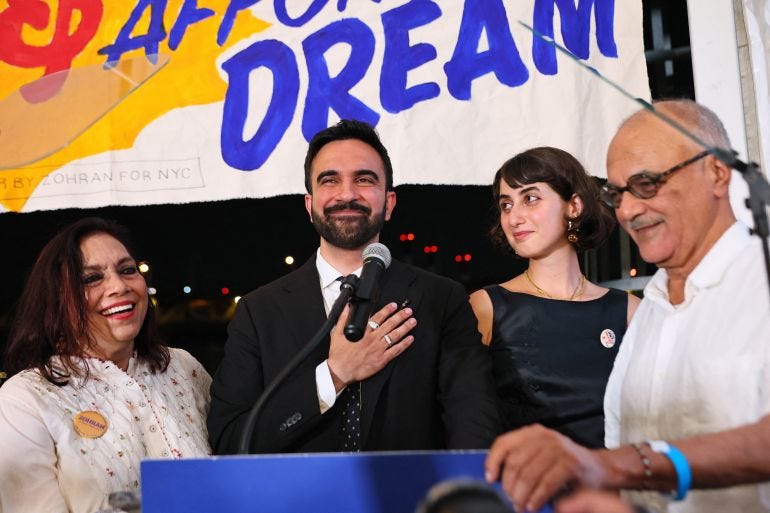
Zohran Mamdani’s rise from a community organizer in Queens to the mayoralty of America’s largest city is not a story of identity politics but of conviction. His campaign centered on housing justice, workers’ rights, and universal childcare, drawing support from across the city’s racial and economic divides. Ghazala Hashmi’s win in Virginia carries its own symbolic resonance. A former professor and state senator, she has long been an advocate for education, civic engagement, and women’s representation. Her victory as the first Muslim woman and the first Indian-American to hold statewide office in Virginia is a milestone in its own right.
What makes these wins extraordinary is not only who they are but where they come from. Both Mamdani and Hashmi trace their heritage to a country that is now witnessing the slow erasure of its Muslim citizens from public life. In India, the world’s largest democracy and home to over 220 million Muslims, there is not a single Muslim representative in the ruling coalition in Parliament. The absence is not accidental. It reflects a political climate in which the world’s third-largest Muslim population has been rendered voiceless in the very institutions that claim to represent them.
This contrast is impossible to ignore. In the United States, Indian-origin Muslims rise through open contests, appealing to broad-based coalitions on issues of policy and justice. In India, Muslims have been systematically excluded from the political mainstream, vilified in public discourse, and reduced to the margins of citizenship. The symbolism of Mamdani and Hashmi’s victories extends beyond celebration; it invites reflection. What does it mean when inclusion flourishes abroad but fades at home?
For many Indian Muslims watching from afar, these victories evoke both pride and pain. Pride in seeing people who share their heritage inhabit positions of visibility and influence. Pain in recognizing that such possibilities have grown remote within India’s own political landscape. The Indian Muslim, once central to the making of the republic, now finds representation mostly in memories and diaspora achievements.
Yet there is also hope in this moment. Mamdani and Hashmi’s campaigns were built not on sectarian appeal but on universal issues — housing, education, social equity, dignity. They demonstrate that Muslim leadership need not be confined to religious identity; it can articulate the public good in inclusive, civic terms. That lesson carries meaning far beyond the United States. For Indian Muslims, it suggests a model of political imagination that transcends survival — one that asserts belonging through competence, empathy, and coalition.
Their victories remind us that representation is not ornamental. It is the scaffolding of democracy itself. When 220 million people are absent from power, democracy begins to fracture from within. When those same people — or their diaspora counterparts — are seen, heard, and trusted, democracy renews itself.
In celebrating Zohran Mamdani and Ghazala Hashmi, we are not only applauding two individual triumphs. We are glimpsing what a plural society looks like when it works — when identity and equality are not adversaries but partners in shaping the public sphere. Their ascent is a mirror held up to India, reflecting both its lost promise and its lingering potential. The question that remains is whether that reflection will inspire introspection — or be turned away from once more.
A thoughtful piece, highlighting the breadth of systems calling themself democracies. Both are flawed, but there is an obvious tension between democracy as identity based majoritarian domination of outsiders, and democracy as the exercise of power in the interests of all citizens. Sadly, there’s also some convergence with the ultra nationalist extremes in both India and the USA. Let’s hope this can be a brief moment of hope that a democracy for all is possible in both India and the USA.
Very profound